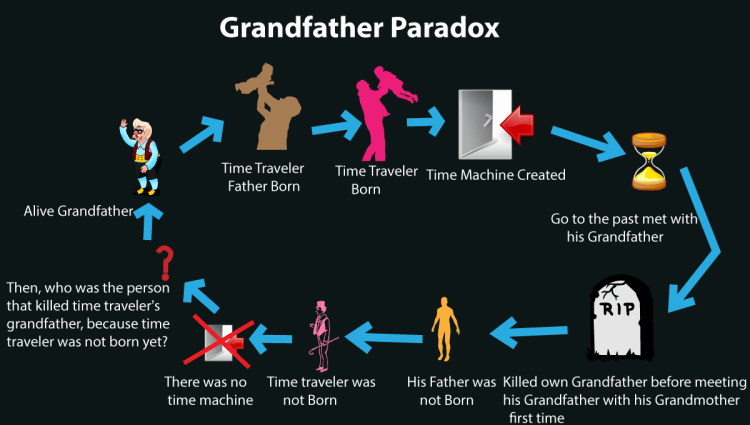
The grandfather paradox is a paradox of time travel in which inconsistencies emerge through changing the past. The name comes from the paradox’s description: a person travels to the past and kills their own grandfather before the conception of their father or mother, which prevents the time traveller’s existence. Despite its title, the grandfather paradox does not exclusively regard the contradiction of killing one’s own grandfather to prevent one’s birth. Rather, the paradox regards any action that alters the past, since there is a contradiction whenever the past becomes different from the way it was.
Early examples
The grandfather paradox was mentioned in written stories as early as 1929. In 1931, it was described as “the age-old argument of preventing your birth by killing your grandparents” in a letter to American science fiction magazine Amazing Stories. Early science-fiction stories dealing with the paradox are the short story Ancestral Voices by Nathaniel Schachner, published in 1933, and the 1944 book Future Times Three by René Barjavel, although a number of other works from the 1930s and 1940s touched upon the topic in various degrees of detail.
Variants
The grandfather paradox encompasses any change to the past, and it is presented in many variations. Physicist John Garrison et al. give a variation of the paradox of an electronic circuit that sends a signal through a time machine to shut itself off, and receives the signal before it sends it. An equivalent paradox is known in philosophy as the “retro-suicide paradox” or “autoinfanticide”, going back in time and killing a younger version of oneself (such as a baby). Another variant of the grandfather paradox is the “Hitler paradox” or “Hitler’s murder paradox”, a fairly frequent trope in science fiction, in which the protagonist travels back in time to murder Adolf Hitler before he can instigate World War II and the Holocaust. Rather than necessarily physically preventing time travel, the action removes any reason for the travel, along with any knowledge that the reason ever existed. Additionally, the consequences of Hitler’s existence are so monumental and all-encompassing that for anyone born after the war, it is likely that their birth was influenced in some way by its effects, and thus the lineage aspect of the paradox would directly apply in some way.
Some advocate a parallel universe approach to the grandfather paradox. When the time traveller kills their grandfather, the traveller is actually killing a parallel universe version of the grandfather, and the time traveller’s original universe is unaltered; it has been argued that since the traveller arrives in a different universe’s history and not their own history, this is not “genuine” time travel. In other variants, the actions of time travellers have no effects outside of their own personal experience, as depicted in Alfred Bester’s short story The Men Who Murdered Mohammed.
Philosophical analysis
Even without knowing whether time travel to the past is physically possible, it is possible to show using modal logic that changing the past results in a logical contradiction. If it is necessarily true that the past happened in a certain way, then it is false and impossible for the past to have occurred in any other way. A time traveller would not be able to change the past from the way it is; they would only act in a way that is already consistent with what necessarily happened.
Consideration of the grandfather paradox has led some to the idea that time travel is by its very nature paradoxical and therefore logically impossible. For example, the philosopher Bradley Dowden made this sort of argument in the textbook Logical Reasoning, arguing that the possibility of creating a contradiction rules out time travel to the past entirely. However, some philosophers and scientists believe that time travel into the past need not be logically impossible provided that there is no possibility of changing the past, as suggested, for example, by the Novikov self-consistency principle. This principle is illustrated in Ted Chiang’s novelette The Merchant and the Alchemist’s Gate. Dowden revised his view after being convinced of this in an exchange with the philosopher Norman Swartz.
 Earthian Society
Nice
LikeLike