Subatomic particle having no known substructure
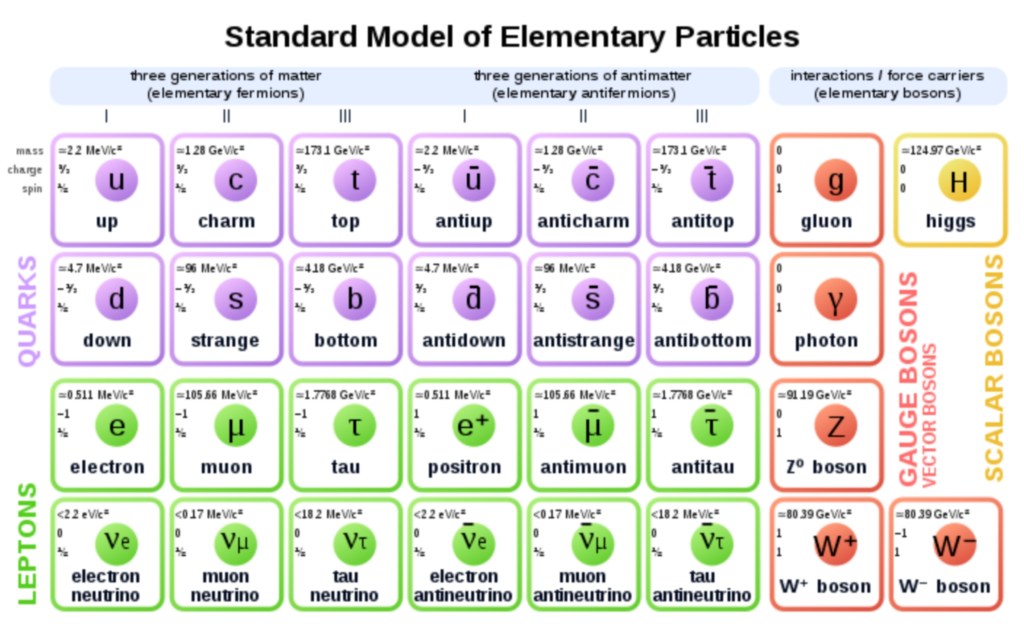
In particle physics, an elementary particle or fundamental particle is a subatomic particle that is not composed of other particles.: 1–3 Particles currently thought to be elementary include the fundamental fermions (quarks, leptons, antiquarks, and antileptons), which generally are “matter particles” and “antimatter particles”, as well as the fundamental bosons (gauge bosons and the Higgs boson), which generally are “force particles” that mediate interactions among fermions.: 1–3 A particle containing two or more elementary particles is a composite particle.
Ordinary matter is composed of atoms, once presumed to be elementary particles—atomos meaning “unable to be cut” in Greek—although the atom’s existence remained controversial until about 1905, as some leading physicists regarded molecules as mathematical illusions, and matter as ultimately composed of energy.: 1–3 Subatomic constituents of the atom were first identified in the early 1930s; the electron and the proton, along with the photon, the particle of electromagnetic radiation.: 1–3 At that time, the recent advent of quantum mechanics was radically altering the conception of particles, as a single particle could seemingly span a field as would a wave, a paradox still eluding satisfactory explanation.
Via quantum theory, protons and neutrons were found to contain quarks – up quarks and down quarks – now considered elementary particles.: 1–3 And within a molecule, the electron’s three degrees of freedom (charge, spin, orbital) can separate via the wavefunction into three quasiparticles (holon, spinon, and orbiton). Yet a free electron – one which is not orbiting an atomic nucleus and hence lacks orbital motion – appears unsplittable and remains regarded as an elementary particle.
Around 1980, an elementary particle’s status as indeed elementary – an ultimate constituent of substance – was mostly discarded for a more practical outlook,: 1–3 embodied in particle physics’ Standard Model, what’s known as science’s most experimentally successful theory. Many elaborations upon and theories beyond the Standard Model, including the popular supersymmetry, double the number of elementary particles by hypothesizing that each known particle associates with a “shadow” partner far more massive, although all such superpartners remain undiscovered. Meanwhile, an elementary boson mediating gravitation – the graviton – remains hypothetical.: 1–3 Also, according to some hypotheses, spacetime is quantized, so within these hypotheses there probably exist “atoms” of space and time themselves.
Overview
All elementary particles are either bosons or fermions. These classes are distinguished by their quantum statistics: fermions obey Fermi–Dirac statistics and bosons obey Bose–Einstein statistics.: 1–3 Their spin is differentiated via the spin–statistics theorem: it is half-integer for fermions, and integer for bosons.
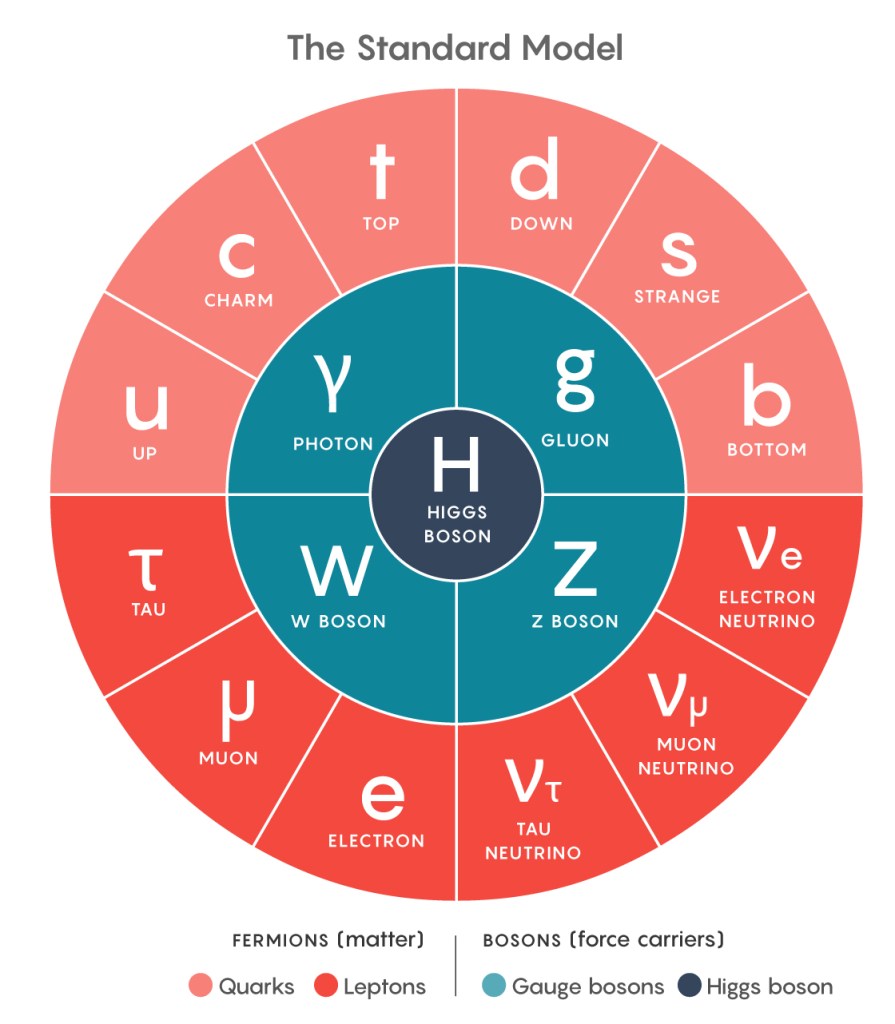
In the Standard Model, elementary particles are represented for predictive utility as point particles. Though extremely successful, the Standard Model is limited to the microcosm by its omission of gravitation and has some parameters arbitrarily added but unexplained.
Cosmic abundance of elementary particles
According to the current models of big bang nucleosynthesis, the primordial composition of visible matter of the universe should be about 75% hydrogen and 25% helium-4 (in mass). Neutrons are made up of one up and two down quarks, while protons are made of two up and one down quark. Since the other common elementary particles (such as electrons, neutrinos, or weak bosons) are so light or so rare when compared to atomic nuclei, we can neglect their mass contribution to the observable universe’s total mass. Therefore, one can conclude that most of the visible mass of the universe consists of protons and neutrons, which, like all baryons, in turn consist of up quarks and down quarks.
Some estimates imply that there are roughly 1080 baryons (almost entirely protons and neutrons) in the observable universe.
The number of protons in the observable universe is called the Eddington number.
In terms of number of particles, some estimates imply that nearly all the matter, excluding dark matter, occurs in neutrinos, which constitute the majority of the roughly 1086 elementary particles of matter that exist in the visible universe. Other estimates imply that roughly 1097 elementary particles exist in the visible universe (not including dark matter), mostly photons and other massless force carriers.
Standard Model
The Standard Model of particle physics contains 12 flavors of elementary fermions, plus their corresponding antiparticles, as well as elementary bosons that mediate the forces and the Higgs boson, which was reported on July 4, 2012, as having been likely detected by the two main experiments at the Large Hadron Collider (ATLAS and CMS).: 1–3 However, the Standard Model is widely considered to be a provisional theory rather than a truly fundamental one, since it is not known if it is compatible with Einstein’s general relativity. There may be hypothetical elementary particles not described by the Standard Model, such as the graviton, the particle that would carry the gravitational force, and sparticles, supersymmetric partners of the ordinary particles.
 Earthian Society