2.2 Classification of Dark Matter
An important categorization scheme for DM particles is the ‘hot’ vs. ‘cold’ classification. Hot Dark Matter (HDM) particles are those that are described by a relativistic equation of state at the time when galaxies could just start to form. And Cold Dark Matter (CDM) particles are those described by non-relativistic equation of state at the time when galaxies could just start to form. Some weakly interacting particles (like WIMPs), Supersymmetric, superstring, higher dimensions, Kaluza Klein etc. could be CDM, forming sub galactic objects first (i.e. bottom-up scenario) (Gelmini, 2006; Cheng, Chu and Tang, 2015).
This categorization has important ramifications for structure formation, and there is a chance of determining whether the dark matter is hot or cold from studies of galaxy formation. Hot dark matter cannot cluster on galaxy scales until it has cooled to non-relativistic speeds, and so gives rise to a different primordial fluctuation spectrum (Davis et al., 1985).
Warm dark matter (WDM) is another hypothesized form of dark matter that has properties intermediate between those of HDM and CDM, causing structure formation to occur bottom-up from above their free-streaming scale, and top-down below their free streaming scale. The most common WDM candidates are sterile neutrinos and gravitinos. WDM particles interact much more weakly than neutrinos. They decouple at temperatures much greater than the QCD temperature, and are not heated by the subsequent annihilation of hadronic species. Consequently their number density is roughly an order of magnitude lower, and their mass an order of magnitude higher, than HDM particles (Silk, 2000).
The cut-off in the power spectrum implied by WDM will inhibit the formation of small DM halos at high redshift. But such small halos are where the first stars form, which produce metals uniformly throughout the early universe as indicated by observations of the Lyman alpha forest.
Thus from observations the current favourite model for the universe is where the matter is mostly CDM (with a large cosmological constant, i.e. LCDM).
2.2.1 Decaying Dark Matter
Dark matter has survived until the present day, accounting for ~26% of the present energy density of the universe. It is still unknown whether these DM particles are absolutely
7stable or they have a finite but very long lifetime. This is a possibility since there is no theoretical basis predicting their stability.
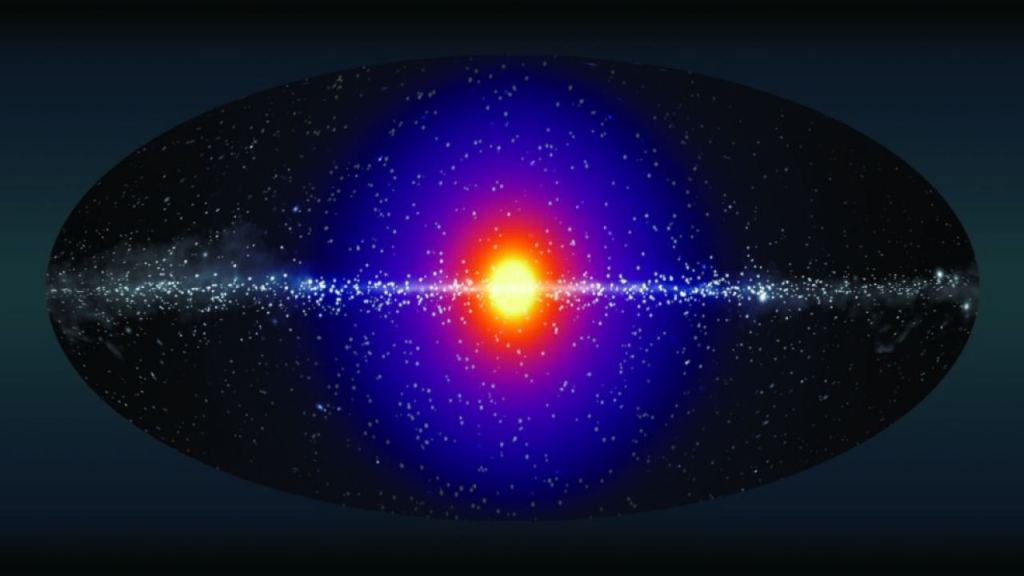
In most models, dark matter stability is imposed ad hoc by imposing extra symmetries. Many particle physics models exist which contain unstable (very long-lived) DM particles. It is conceivable that the dark matter stability could be due to symmetry of the renormalisable part of the Lagrangian which is broken by higher dimensional operators, which could thus induce the dark matter decay (Bertone, Hooper and Silk, 2005).
Emission line-like spectral feature at energy E ~3.5 keV in the long exposure X-ray observations of a number of dark matter-dominated objects, such as the stack of 73 galaxy clusters (Bulbul et al., 2014) and in the Andromeda galaxy and the Perseus galaxy cluster (Boyarsky et al., 2014) has recently been observed. The possibility that this spectral feature may be the signal from decaying DM has sparked a lot of interest, and many dark matter models explaining this signal have been proposed.
2.3 What Dark Matter Cannot Be
2.3.1 Massive Astrophysical Compact Halo Object
The observed abundance of light elements created during the primordial nucleosynthesis
can rule out the possibility that DM particles are baryonic in nature. The primordial nucleosynthesis strongly depends on the baryon-photon ratio. This is also supported by the observations of cosmic microwave background radiation.
The main baryonic candidates are the Massive Astrophysical Compact Halo Object (MACHO) class of candidates. These include brown dwarf stars, Jupiter-like planets, and 100 solar mass black holes.
Brown dwarfs are spheres of H and He with masses below 0.08 solar mass, so they never begin nuclear fusion of hydrogen. The MACHO project which analysed microlensing events from the Large Magellanic Cloud indicates that such objects can account for only about 10 – 20% of the missing DM (MACHO Collaboration, Alcock et al., 2000).
Another group, the EROS-2 collaboration does not confirm the signal claims by the MACHO group. They did not find enough microlensing effect with sensitivity higher by a factor of 2 (Tisserand et al., 2007).
These searches have ruled out the possibility that these objects make up a significant fraction of dark matter in our galaxy.
2.3.2 Hot Dark Matter and Neutrinos
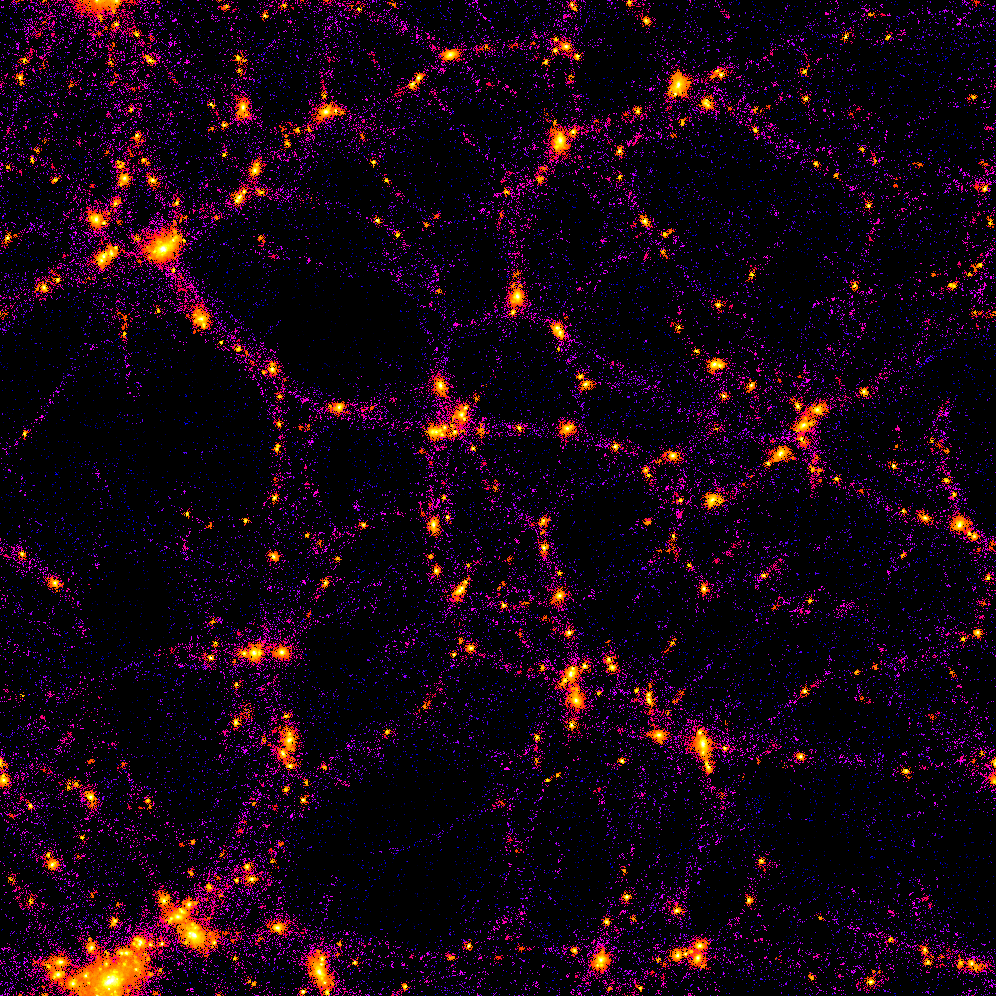
The formation of such large scale structures raises few questions, including the very existence of large scale structures in just a few billion years, from a smooth homogeneous (uniform density) expanding universe and which objects formed first (top-down or bottom-up process).
Early analysis due to Jeans (1902) (much before discovery of Hubble), gives the balance between dissipative pressure force and attractive gravity in a medium of pressure P and density rho( ρ ), i.e. PdV Gravitational energy. This implies that there is a minimal size R, for structures to grow under its own gravity, which is given by:

In an expanding medium,
where ρ α t², like the Friedmann-Robertson-Walker (FRW)
universe, growth rate is not exponential, but follows power law. Any inhomogeneity in density, characterized as
(ρ – ρₐᵥ)/ρₐᵥ = δp/p = δ,
grows under gravity with time, where ρₐᵥ is the average density.
The inhomogeneity described by δ, are believed to have formed very early, during the inflation era. The primordial fluctuations (of scalar field) were already imprinted on it.
In expanding universe any gravitational contraction has to counteract expansion of ambient medium and pressures (also dark energy), with |δ|>> 1 at end of structure formation process. In the beginning |δ|<< 1; when|δ|~ 1 the non linear growth imprints on CMB and this survives undistributed from recombination epoch.
So fluctuations ∆T/T (on different angular scales), must be accounted for in terms of matter-radiation interaction prior to the recombination era. Small fluctuations (∆T/T < 10^-4 ),
imply the presence of dark matter. Dark matter would have decoupled much earlier, (for massive particles) and started clumping early to provide the required seeds for δ. Hot DM gives early large scale structures which are contrary to observations where as cold DM implies a bottom up scenario. This therefore rules out the possibility that relativistic neutrinos could account for the missing dark matter (Springel et al., 2005; Bertone and Merritt, 2005).
The neutrino oscillations, which measure the mass difference squared, i.e. ∆m² = m₁² – m₂² ,
between two species 1 and 2 (or more precisely what is obtained is the product of Dm 2 and the mixing angle, i.e. ∆m² sin²2θ ) imply that at least one of the three neutrino
species has a tiny mass, possibly of the order of one or a few electron volts.
For neutrinos of given energy E, the oscillation length scales as, E / ∆m². ∆m² is typically of the order
10^(−2) − 10^(−4) eV². Independent cosmological evidence, for instance, from the Planck 2015 temperature and polarization data suggest that the sum total of masses is less than ~0.126eV (Di Valentino et al., 2015; Hinshaw et al., 2013; Beringer et al., 2012; Sivaram and Sinha, 1974). This is also suggested by double β decay experiments and earlier tritium decay end point analysis also implies a few electron volts (Bahcall, 1989).
Neutrinos are expected to have been produced profusely in the very initial stages of the universe, i.e. in the hot big bang. Similar to the microwave background which is the fossil remnant of the hot radiation (high energy radiation) which characterized the best dense phase of the early universe epochs (cooling with expansion) we also expect a fossil remnant of neutrinos which also now form a background with an estimated density of about 150 1/cm³ , per species, so
that summed over all six species (neutrinos and anti neutrinos), we expect a fossil neutrino background with a number density of one thousand per cubic centimetre (Quigg, 2008).
Even with a neutrino number density of thousand per cc, with low mass of 0.1eV to 0.01eV implied by neutrino oscillations, would account for less than a percent of the missing DM.
2.3.3 Other Proposed Candidates
There are many other models for DM particles that are proposed which can be ruled out from basic astrophysical considerations. In one such alternate approach to dark matter, Drexler assumes that highly relativistic protons trapped in the halo of the galaxies due to the galaxies’ magnetic field could possibly account for the yet unseen DM (Drexler, 2009). Various energetics involved in such a scenario indicate that this model is not plausible.
The energy of these highly relativistic protons required to be trapped in an orbit of radius ~30kpc in the galactic magnetic field of ~10^(-6) G is,
εₚ ~ 10^16 eV. To account for ~10^12 solar mass of DM in each galaxy, the number of such high energy protons required is, nₚ ~ 10^62. The total number of protons in the galaxy is of the order of about 10^67; i.e. one in every 10^5 protons should be ultra-relativistic. The only source of such high energy protons is supernova explosions. The number of supernovae required to produce the required number of these protons will be ~10^15 , which is about 10^5 SN/year, which is much (a million times) above the observed limit.
The excess charge of ~10^62 relativistic protons in the halo of each galaxy required to account for the missing DM will cause a tremendous Coulomb repulsion between them (eleven orders greater than their gravitational attractions). For the gravitational attraction between Milky Way and the Andromeda galaxies to dominate, the maximum charge is constrained to be, Q = (√G)M ≈ 10^(51) e, which is ~10^11 orders smaller than the number of relativistic protons required to account for the dark matter. Hence such a scenario is not viable (Sivaram, Arun and Nagaraja, 2011a).
Another alternate explanation for the flat rotation curve of the spiral galaxy is with an analogy with electromagnetism. Fahr (1990) has postulated a gravo-inductive force distinct from the usual Newtonian force. The exact analogy with electromagnetism assumed in postulating this force would for reason of consistency imply a vanishingly small coupling rather than the anomalously large coupling required. Hence such a gravo-inductive force cannot account for the flat rotation curve (Sivaram, 1993).
There are other earlier candidates that are ruled out by non-astrophysical considerations
(Trimble, 1988). These include, majoron and goldstone boson (10^(-5)eV like axion), paraphoton and right-handed neutrino, keV particles from modified QCD and superweak theory, cosmion, flatino, magnito (MeV to GeV particles from SUSY and supergravity), preons, multi TeV particles, pyrgons, maximos, Planck mass particles in higher dimension theories, etc.
Other baryonic candidates that are ruled out from gravitational lensing observations; since they contribute too little to DM; include brown dwarfs, old white dwarfs, neutron stars, stellar mass black holes, solid H₂, dense cold molecular clouds in galaxies (which are firmly ruled out by the absence of absorption) (Clarke et al., 2004), high velocity clouds of H₂, and lensing also rules out stellar mass quark nuggets, boson stars, strange quark nuggets, KleinKaluza gravitino trapped inside neutron stars, branons, lightest Klein-Kaluza bosons, (Casse et al., 2004) etc. Studies on decaying CDM and annihilation of DM (Sigurdson and Kamionkowski, 2004; Boehm et al., 2004) also rule out many possible DM candidates.
LIMPs are DM particles that weakly interact only with leptons and have masses of 1 to 10 TeV (Baltz and Bergstrom, 2003). As the interactions are only leptonic, current elastic scattering experiments are not sensitive to this particle and these predictions rely heavily on the structure of the Galactic halo.
Another proposed DM particle is the superWIMPs (superweakly-interacting massive
particles) (Feng, Rajaraman and Takayama, 2003). Such particles appear in the form of gravitinos and gravitons in theories with supersymmetry and extra dimensions. They satisfy existing constraints from the big bang nucleosynthesis and CMB but are indistinguishable in conventional DM experiments.
Part III is already published …
 Earthian Society