Before starting this discussion, I just want to say that you will not be getting alot of mathematics involved in this discussion, but after completion of this blog you will definitely be able to,
- Compare and contrast different types of particle accelerators
- Describe the purpose, components, and function of a typical colliding beam machine
- Explain the role of each type of subdetector of a typical multipurpose particle detector
- Use the curvature of a charge track to determine the momentum of a particle
The goal of experimental particle physics is to accurately measure elementary particles. The primary method used to achieve this end is to produce these particles in high-energy collisions and then measure the products of using highly sensitive particle detectors. These experiments are used to test and revise scientific models of particle interactions. The purpose of this section is to describe particle accelerators and detectors. Modern machines are based on earlier ones, so it is helpful to present a brief history of accelerators and detectors.
Early Particle Accelerators
A particle accelerator is a machine designed to accelerate charged particles. This acceleration is usually achieved with strong electric fields, magnetic fields, or both. A simple example of a particle accelerator is the Van de Graaff accelerator (see Electric Potential. This type of accelerator collects charges on a hollow metal sphere using a moving belt. When the electrostatic potential difference of the sphere is sufficiently large, the field is used to accelerate particles through an evacuated tube. Energies produced by a Van de Graaff accelerator are not large enough to create new particles, but the machine was important for early exploration of the atomic nucleus.
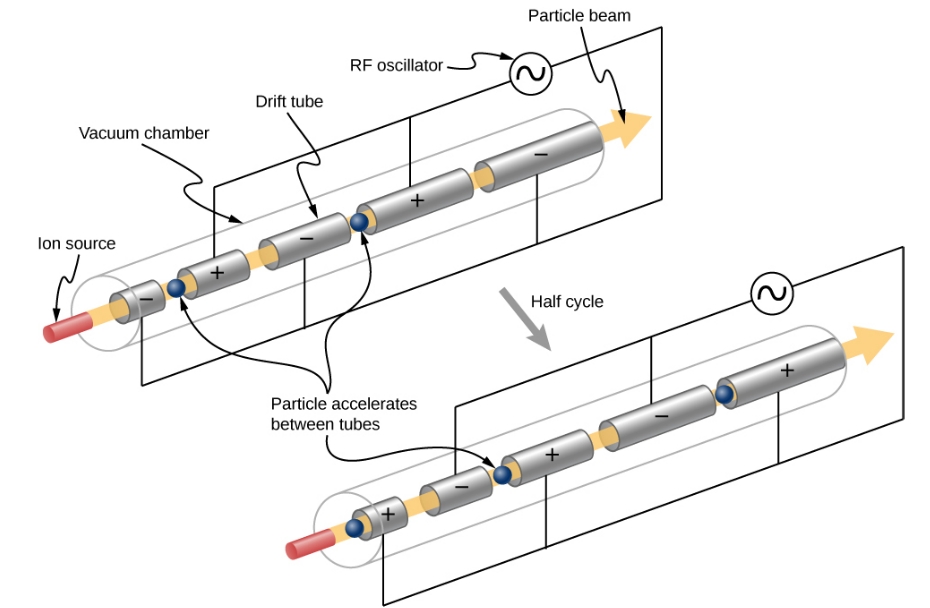
Larger energies can be produced by a linear accelerator (called a “linac”). Charged particles produced at the beginning of the linac are accelerated by a continuous line of charged hollow tubes. The voltage between a given pair of tubes is set to draw the charged particle in, and once the particle arrives, the voltage between the next pair of tubes is set to push the charged particle out. In other words, voltages are applied in such a way that the tubes deliver a series of carefully synchronized electric kicks (Figure 1.1). Modern linacs employ radio frequency (RF) cavities that set up oscillating electromagnetic fields, which propel the particle forward like a surfer on an ocean wave. Linacs can accelerate electrons to over 100 MeV. (Electrons with kinetic energies greater than 2 MeV are moving very close to the speed of light.) In modern particle research, linear accelerators are often used in the first stage of acceleration.
Example 1.1
Accelerating Tubes
A linear accelerator designed to produce a beam of 800-MeV protons has 2000 accelerating tubes separated by gaps. What average voltage must be applied between tubes to achieve the desired energy? (Hint: U = qV.)
Strategy
The energy given to the proton in each gap between tubes is U = qV, where q is the proton’s charge and V is the potential difference (voltage) across the gap. Since q = q(e) = 1.6 × 10⁻¹⁹C and 1 eV = (1 V)(
(1.6 × 10^−19 C ), the proton gains 1 eV in energy for each volt across the gap that it passes
through. The ac voltage applied to the tubes is timed so that it adds to the energy in each gap. The effective voltage is the sum of the gap voltages and equals 800 MV to give each proton an energy of 800 MeV.
Solution
There are 2000 gaps and the sum of the voltages across them is 800 MV. Therefore, the average voltage applied is 0.4 MV or 400 kV.
Significance
A voltage of this magnitude is not difficult to achieve in a vacuum. Much larger gap voltages would be required for higher energy, such as those at the 50-GeV SLAC facility. Synchrotrons are aided by the circular path of the accelerated particles, which can orbit many times, effectively multiplying the number of accelerations by the number of orbits. This makes it possible to reach energies greater than 1 TeV.
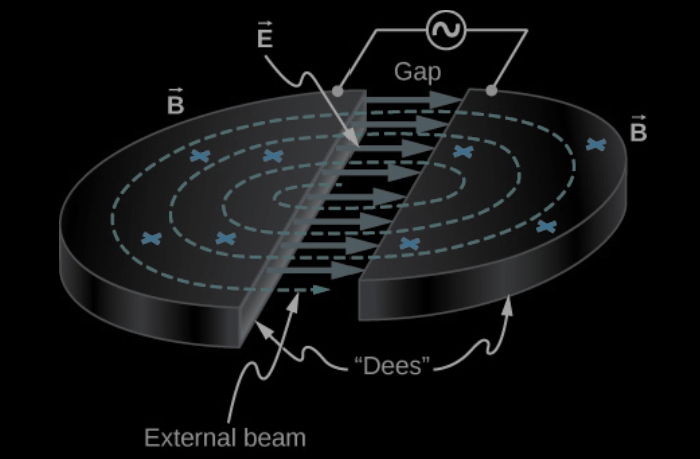
The next-generation accelerator after the linac is the cyclotron (Figure 1.2). A cyclotron uses alternating electric fields and fixed magnets to accelerate particles in a circular spiral path. A particle at the center of the cyclotron is first accelerated by an electric field in a gap between two D-shaped magnets (Dees). As the particle crosses over the D-shaped magnet, the particle is bent into a circular path by a Lorentz force. Assuming no energy losses, the momentum of the particle is related to its radius of curvature by

where p is the momentum in GeV/c, B is in teslas, and r is the radius of the trajectory (“orbit”) in meters. This expression is valid to classical and relativistic velocities. The circular trajectory returns the particle to the electric field gap, the electric field is reversed, and the process continues. As the particle is accelerated, the radius of curvature gets larger and larger—spirally outward—until the electrons leave the device.
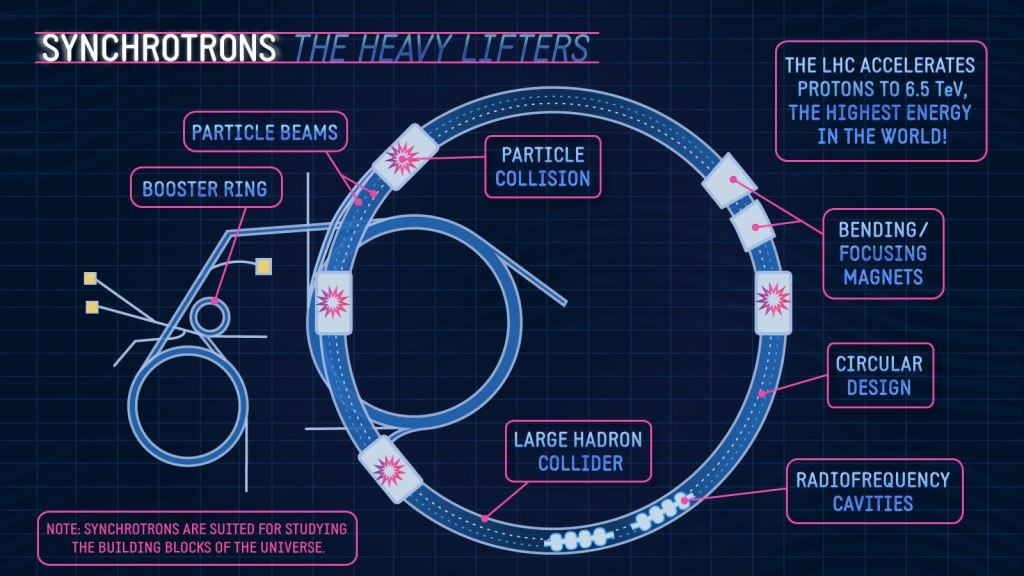
A synchrotron is a circular accelerator that uses alternating voltage and increasing magnetic field strength to accelerate particles to higher energies. Charged particles are accelerated by RF cavities, and steered and focused by magnets. RF cavities are synchronized to deliver “kicks” to the particles as they pass by, hence the name. Steering high-energy particles requires strong magnetic fields, so superconducting magnets are often used to reduce heat losses. As the charged particles move in a circle, they radiate energy: According to classical theory, any charged particle that accelerates (and circular motion is an accelerated motion) also radiates. In a synchrotron, such radiation is called synchrotron radiation. This radiation is useful for many other purposes, such as medical and materials research.
Colliding Beam Machines
New particles can be created by colliding particles at high energies. According to Einstein’s mass-energy relation, the energies of the colliding particles are converted into mass energy of the created particle. The most efficient way to do this is with particle-colliding beam machines. A colliding beam machine creates two counter-rotating beams in a circular accelerator, stores the beams at constant energy, and then at the desired moment, focuses the beams on one another at the center of a sensitive detector.
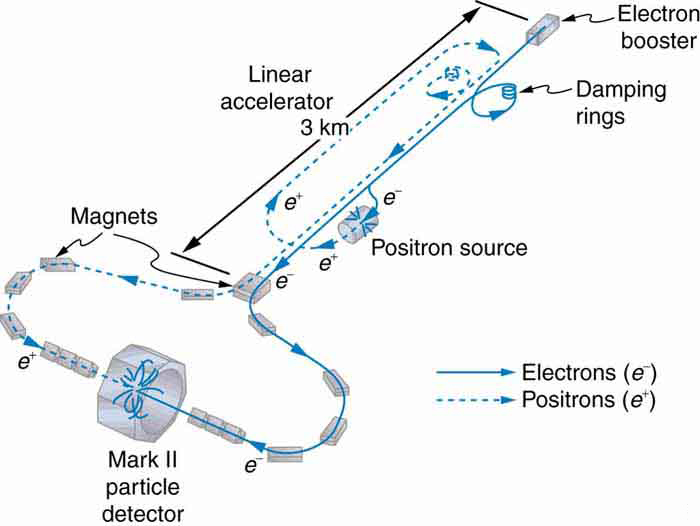
The prototypical colliding beam machine is the Cornell Electron Storage Ring, located in Ithaca, New York (Figure 1.3). Electrons ( e− ) and positrons ( e+ ) are created at the beginning of the linear accelerator and are accelerated up to 150 MeV. The particles are then injected into the inner synchrotron ring, where they are accelerated by RF cavities to 4.5 to 6 GeV. When the beams are up to speed, they are transferred and “stored” in an outer storage ring at the same energy. The two counter-rotating beams travel through the same evacuated pipe, but are kept apart until collisions are desired. The electrons and positrons circle the machine in bunches 390,000 times every second.
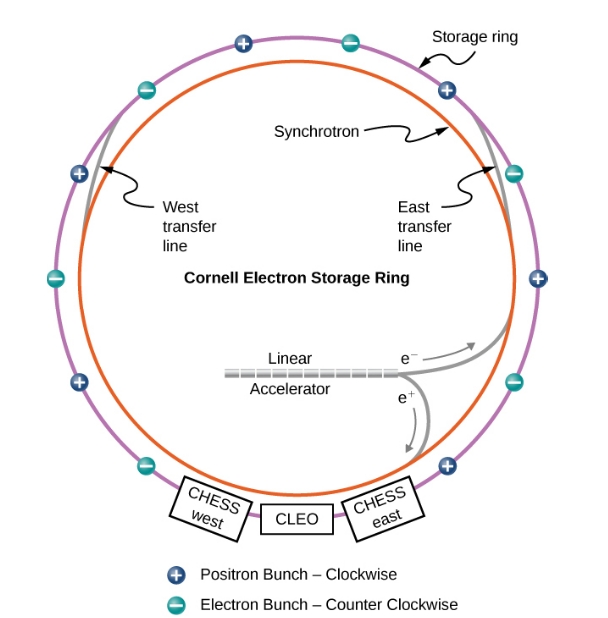
When an electron and positron collide, they annihilate each other to produce a photon, which exists for too short a time to be detected. The photon produces either a lepton pair (e.g., an electron and position, muon or antimuon, or tau and antitau) or a quark pair. If quarks are produced, mesons form, such as cc−
and bb −
. These mesons are created nearly at rest since the
initial total momentum of the electron-positron system is zero. Note, mesons cannot be created at just any colliding energy but only at “resonant” energies that correspond to the unique masses of the mesons (Table 11.5 in previous blog). The mesons created in this way are highly unstable and decay quickly into lighter particles, such as electrons, protons, and photons. The collision “fragments” provide valuable information about particle interactions.
As the field of particle physics advances, colliding beam machines are becoming more powerful. The Large Hadron Collider (LHC), currently the largest accelerator in the world, collides protons at beam energies exceeding 6 TeV. The center-ofmass energy  refers to the total energy available to create new particles in a colliding machine, or the total energy of incoming particles in the center-of-mass frame. Therefore, the LHC is able to produce one or more particles with a total mass exceeding 12 TeV. The center-of-mass energy is given by:

where E1 and E2 are the total energies of the incoming particles (1 and 2), p1 and p2 are the magnitudes of their momenta, and m1 and m2 are their rest masses.
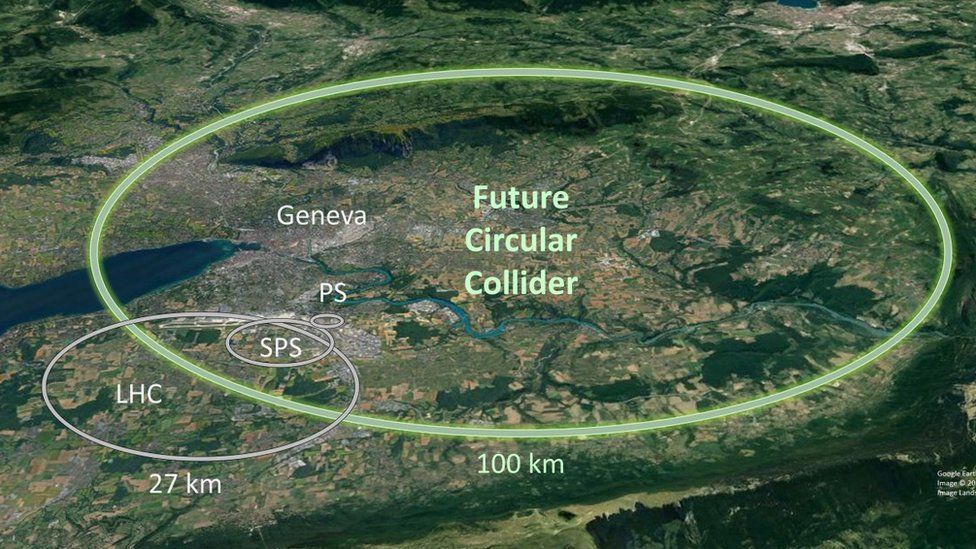
Higher beam energies require larger accelerators, so modern colliding beam machines are very large. The LHC, for example, is 17 miles in circumference (Figure 1.4). (In the 1940s, Enrico Fermi envisioned an accelerator that encircled all of Earth!) An important scientific challenge of the twenty-first century is to reduce the size of particle accelerators.
 Earthian Society
Again back, with a groundbreaking knowledgeable content, I am lovin. It.
Lear from physics teacher❌
Learn from Aashutosh’s Blog☑️
LikeLiked by 1 person
I mean learn by the way😩
LikeLike
Now, Harisson wells will look into your blog.
As his particle accelerator was failed.
LikeLike